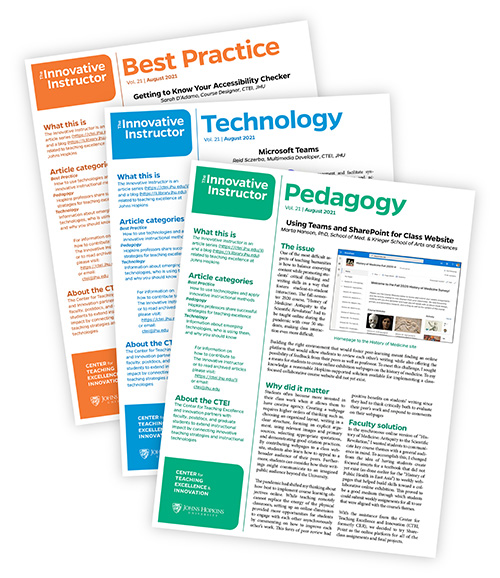
The Innovative Instructor is a print series for articles on teaching excellence at Johns Hopkins University. Written by Hopkins faculty or campus instructional technology experts, the goal is to increase communication about effective teaching solutions and how to achieve them. Through these articles, instructors can share successful teaching strategies, learn what colleagues are doing, and discover new technologies and skills for the classroom or professional development. To learn more about this series or to write an article, contact ctei@jhu.edu.
No items on the page match this filter.
Either, clear the filter and try again or reset the search.
-
May 2023
Best Practice #23
Mary Talalay,
Sr. Instructional Technologist, CTEI, JHU
Wax nostalgically about the days before personal computers or smartphones in classrooms and you can almost hear the collective eye rolls. Higher education existed without the use of technology longer than it has with it. The University of Bologna, founded in 1088, is credited with being the world’s oldest university in the western world; Drexel University is credited as being the first university to require each student to have a personal computer in the early 1980s. If my recollection of math, tested only via written exams, serves me, the US has had about 40 years with personal technology-aided education and the world has about 940 years without. With the increase in use of artificial intelligence (AI) in education, maybe it is time to consider other options for teaching and assessment and look back to the first 900 years of education to rediscover these methods.
-
May 2023
Pedagogy #23
Reid Sczerba,
Digitial Solutions Designer, CTEI, JHU
Once upon a time, just before the age of COVID-19, I was asked to teach a course for an undergraduate minor program through JHU’s Center for Leadership Education. I began my
journey to teaching my first course by meeting the program director for lunch. After the proposition, it became clear to me that there was sparse content for this new course on data visualization, and it would be up to me to develop and deliver it the following semester. With only a few months to prepare, I quickly realized that my quest to create something from
nothing would be full of challenges that might result in a perilous journey, but the bounties were rumored to be plentiful.
-
May 2023
Technology #23
Lena Denis,
Librarian, JHU Data Services
ArcGIS StoryMaps is an immersive, interactive web-based presentation tool that gives you the power to share your research in narrative form at a single URL you can share with as few or as many people as you would like. As the name implies, the format was originally developed for showcasing web-created maps, and it does so effectively, but even if you don’t have any maps in your presentation at all, StoryMaps provides a visually appealing media-rich format for displaying images, video, and embedded graphics of all kinds. ArcGIS StoryMaps is a paid, licensed platform, but the Sheridan Libraries’ Data Services department mediates free access for all Hopkins affiliates.
-
August 2022
Best Practice #22
Margaret Burri,
Assistant Director, Academic Liaison Sheridan Libraries, JHU
If you can imagine a world where books and databases were not cataloged, it would be nearly impossible to find and build on existing knowledge. The Sheridan Libraries curate and organize resources available to the Hopkins community and Academic Liaisons are at the forefront of that effort. As content specialist librarians, Academic Liaisons help library users find supporting academic materials for their research, teach them to evaluate content, and expand access to discipline specific databases and resources made available to the Hopkins community. Not only do they know what databases exist for any given subject, they also know the most efficient ways to search them to find what is needed. This can save researchers a great deal of time and effort. If there’s a resource we don’t have here at Hopkins, your liaison librarian can work with you to get it.
-
August 2022
Pedagogy #22
Anne Eakin Moss,
Assistant Professor, Comparative Thought and Literature
Hale Sirin,
Ph.D. Candidate, Comparative Thought and Literature
When preparing to teach a humanities course with a substantial use of media resources, many questions arise. How can we give students access to a wide range of audiovisual, image, and text sources located on multiple different online platforms? What’s the most efficient way for the instructor to access these materials in class spontaneously, and for students to be able to work with the materials on their own? Can we do this in a way that allows for critical engagement and sparks new associations? Can we make that engagement interactive?
To begin answering those questions for our media-intensive courses, we created an online space that would inherently promote critical thinking, comparison and self-driven research, and encourage the students to pursue the links between different films from different geographies. Thus, we customized an instance of Omeka, an online exhibition software, into such an interactive media platform. While initially envisioned as a supplement to the in-person classroom, this platform proved to be a great asset after switching to online learning in Spring 2020.
-
August 2022
Technology #22
Reid Sczerba,
Digital Solutions Designer, CTEI, JHU
Canvas is a learning management system (LMS) that allows instructors to organize and deliver course content to students whether face to face, online, or in a blended learning setting. As one of the leading LMS options for both higher education and K-12, instructors use Canvas to facilitate learning and share resources with students. A Canvas course site provides a consistent method of delivering course content, where the amount of interface customizations are minimized in an effort to streamline content creation and delivery.
-
August 2021
Best Practice #21
Sarah D’Adamo,
Course Designer, Center for Teaching Excellence and Innovation
Accessibility is an approach to online content and our learning environments that provides equitable opportunity and ease of use for everyone, regardless of limitation or disability. An accessible experience or resource is free from barriers, enabling the user to focus on what is being communicated in the material’s content. Guidelines for building accessibility into materials presented online have been published for Johns Hopkins University staff and instructors based on the Worldwide Web Consortium’s WCAG 2.0 AA. In practical terms, these guidelines inform a set of accessibility best practices for instructional materials that should be integrated into our learning environments and experiences to foster flexibility and success for all students. Fortunately, when creating documents and files, most applications offer Accessibility Checkers, which provide guidance for the creation process.
-
August 2021
Pedagogy #21
Marta Hanson,
PhD, School of Medicine & Krieger School of Arts and Sciences
One of the most difficult aspects of teaching humanities is how to balance conveying content while promoting students’ critical thinking and writing skills in a way that fosters student-to-student interaction. The fall-semester 2020 course, “History of Medicine: Antiquity to the Scientific Revolution” had to be taught online during the pandemic with over 50 students, making class interaction even more difficult.
Building the right environment that would foster peer-learning meant finding an online platform that would allow students to review each other’s writing while also offering the possibility of feedback from their peers as well as professor. To meet this challenge, I sought a means for students to create online exhibition webpages on the history of medicine. To my knowledge a reasonable Hopkins-supported solution available for implementing a classfocused collaborative course website did not yet exist.
-
August 2021
Technology #21
Reid Sczerba,
Multimedia Developer, Center for Teaching Excellence and Innovation
Microsoft Teams is a collaboration platform that offers an online space for working on projects, facilitating events, workshops, or classes, and communicating with peers, colleagues, or students. It is highly integrated with other Microsoft Office applications making it convenient when working on documents in its shared space. Teams can act as the place where files can be shared, stored, or collaboratively worked on.
While there are many practical applications for its use in business, Teams also has education related features. A Class Team allows the instructors to create assignments, manage class discussions, review student performance statistics, to name a few. The additional tools provided in a Class Team can make it a viable alternative or supplemental tool to the university’s learning management system.
-
August 2019
Best Practice #20
Amy Brusini,
Senior Instructional Designer, CTEI, Homewood, JHU
Celine Greene,
Senior instructional Technologist, CTL, BSPH, JHU
Donna Schnupp,
Instructional Design Lead and Manager, SoE, JHU
Universal Design for Learning (UDL) is a research-based educational framework that supports the idea that learning environments should be accessible for all, ensuring that every student has an equal opportunity to succeed. Just as the concept of Universal Design (UD) has been applied to our physical environment-i.e. curb cuts, automatically opening doors, etc.-the goal of UDL is to enhance learning experiences by breaking down barriers to learning and building flexibility into the curriculum from the outset. The Center for Applied Special Technology (CAST, http://www.cast.org) organization is credited with pioneering the research behind this philosophy.
-
September 2019
Pedagogy #20
Jennifer Bernstein,
Lecturer, Center for Leadership Education, WSE, JHU
The culture of the medical profession is continually evolving; issues ranging from the cost of health care to demographic changes are just some of the factors influencing the culture surrounding medical professionals in the United States. As an instructor in this field, it is imperative to keep things as current for students as possible. In my class, Culture of the Medical Profession, I am constantly integrating new content from the news, twitter feeds, Instagram, and other sources. When newsworthy items arise, which is multiple times per week, I need to be able to notify students about these developments quickly and efficiently. I also want to spark conversation among the students about these developments as they happen. In Blackboard, where much of my course content resides, the synchronous communication tools available do not offer me an effective solution to keeping students informed and up-to-date; I find posting new content in Blackboard cumbersome and time-consuming, and the chat areas offer little interest when compared with commonly used platforms like Twitter.
-
August 2019
Technology #20
Brian Cole,
Instructional Technologist, Center for Teaching Excellence and Innovation
Zoom is a cloud based platform for collaborating, conferencing, and meeting online. Zoom is easy to use and has a modern design with extensive mobile compatibility. Users can share presentations and the contents of their screens as well as view multiple simultaneous audio and video streams of meeting participants.
-
July 2019
Best Practice #19
Lael J. Ensor-Bennett,
Assistant Curator, Visual Resources Collection, JHU
High quality images are large in size, in-focus, and depict color and tone accurately. Useful images are relevant to your courses or research subject. Properly accessible images are easy to find and free of cost to you. Together, these traits reveal the truly fantastic digital image.
-
July 2019
Pedagogy #19
James M. Culhane, Ph.D.,
Professor and Chair, Department of Pharmaceutical Sciences at Notre Dame of Maryland University School of Pharmacy, and JHU Teaching Academy presenter
If you are like me, much of your time is spent ensuring that the classroom learning experience you provide for your students is stimulating, interactive and impactful. But how invested are we in ensuring that what students do outside of class is productive? Based on my anecdotal experience and several studies looking at study strategies employed by students, the answer to this question is not nearly enough! Much like professional athletes or musicians, our students are asked to perform at a high level, mastering advanced, information dense subjects; yet unlike these specialists who have spent years honing the skills of their craft, very few students have had any formal training in the basic skills necessary to learn successfully.
-
July 2019
Technology #19
Reid Sczerba,
Multimedia Developer, Center for Teaching Excellence and Innovation
Gradescope is a grading platform for course assignments and exams. It is used by instructors and teaching assistants to make the grading process more efficient and consistent, providing quality feedback for students regardless of the size of the course. It can be used to grade existing paper-based assignments and exams or to create a variety of online assignments, including bubblesheet and programming assignments.
-
August 2018
Best Practice #18
Macie Hall,
Senior Instructional Designer, CTEI, JHU
Backward Design is a framework for course design. With Backward Design an instructor starts course planning by identifying desired learning outcomes with the articulation of course goals and learning objectives. Assessment of those goals and objectives is determined, and finally, appropriate learning activities and instruction are developed.
-
August 2018
Pedagogy #18
Rebecca Kelly,
Associate Teaching Professor, Earth and Planetary Sciences, JHU
What do course grades mean? What do they actually measure? In this age of grade inflation and widely varying standards, both teachers and students struggle to define what an A, B, or C in a course really means in terms of student learning and achievement. At the same time, many teachers are overwhelmed by their grading load and are looking for ways to reduce and simplify it without trivializing their course assignments.
-
August 2018
Technology #18
Reid Sczerba,
Multimedia Developer, CTEI
New Google Sites is an online website creation platform. It doesn’t require web development or design experience to create sites that work well on mobile devices. The New Google Sites application is included with the creation tools offered in Google Drive, making it easier to share and integrate your Google Drive content.
-
February 2018
Best Practice #17
Amy Brusini,
Instructional Technology Specialist, Center for Teaching Excellence and Innovation
Writing test questions is a daunting task for many instructors. It can be challenging to correctly assess students on the comprehension of course objectives. Multiple choice questions are no exception; despite being very popular, instructors often struggle to create well-constructed questions.
-
February 2018
Pedagogy #17
Scott Smith,
Professor, Computer Science, JHU
Grading can be one of the most time consuming and tedious aspects of teaching a course, but it’s important to give prompt and meaningful feedback to your students. In large courses, aligning grading practices across multiple teaching assistants (TAs) necessitates a level of coordination that includes scheduling grading meetings, reviewing materials for correct answers, and calibrating point evaluations, all of which can take up valuable time during the semester.
-
July 2017
Best Practice #16
Richard Shingles,
Lecturer, Biology Department
Michael J. Reese Jr.,
Director, Center for Teaching Excellence and Innovation
Effective teaching starts with thoughtful course planning. The first step in preparing a course is to clearly define your course learning goals. These goals describe the broad, overarching expectations of what students should be able to do by the end of the course, specifically what knowledge students should possess and/or what skills they should be able to demonstrate. Instructors use goals to design course assignments and assessments, and to determine what teaching methods will work best to achieve the desired outcomes.
-
August 2017
Pedagogy #16
Marian Feldman,
Professor, Art History and Near Eastern Studies
One of the more challenging aspects in developing a new course is choosing an appropriate educational technology to achieve my learning goals. The material in my course “Creating Sacred Space in the Ancient and Medieval World” lent itself to a visually focused approach to help students understand these sacred spaces and interpret the intents of their creators and builders. The course engaged students with undertaking their own research about ancient spaces and the culture that surrounds them by studying floor plans, technical drawings, photographs, and other relevant images. Ideally, the way to explore broad questions about what makes a place sacred and how it differs from other spaces is to include visual references to provide spatial context that can be aligned with material meaning.
-
August 2017
Technology #16
Reid Sczerba,
Multimedia Developer, CTEI
SketchUp is a three-dimensional rendering application that uses a sketch-based approach for creating models. It may be beneficial to anyone looking to visualize three-dimensional structures, spaces, or objects. With a free-to-use version available for download, SketchUp is an affordable way to develop 3D models. It is easy to learn compared to professional 3D graphic software packages.
-
May 2017
Best Practice #15
Reid Sczerba,
Multimedia Developer, CTEI, JHU
Visual design, in the form of advertisements, entertainment, functional signage, etc., can be seen everywhere. You are constantly processing visual information to make sense of the world and, often unconsciously, you place value judgements on what you see. It is important to consider this when designing or creating visual content for presentation, as there are a number of design strategies that will make that content clear, persuasive, perhaps even beautiful. Visual clarity will help to improve the delivery of the message. This article provides principles that will help you to create clear and concise visual design.
-
May 2017
Pedagogy #15
Elizabeth Mendenhall,
PhD Candidate, Political Science, JHU
In the global environmental politics classroom, the problem of student attitude is often acute: students of global environmental governance are particularly prone to negative emotional reactions, including feelings of helplessness and hopelessness, which can engender apathy and cynicism.
-
May 2017
Technology #15
Bonni Wittstadt,
Geospatial Service Librarian, MSE Library
ArcGIS is a powerful data mapping application that helps you visualize, analyze, and understand spatial data mapped to a coordinate system. Used in the sciences, engineering, and the humanities ArcGIS can reveal relationships, patterns, and trends related to physical spaces in ways that may not have been initially apparent. In addition to mapping objects on the Earth’s surface, there are 3D solutions that allow above and below surface examination. It is also possible to work on expansive scale, e.g., the universe or on a small scale, e.g., the human body. In essence, if it can be mapped, ArcGIS is the tool to use.
-
July 2016
Best Practice #14
Richard Shingles,
Lecturer, Biology Department
Traditionally instructors have used assessments such as midterm exams, final projects or papers, or recitals to measure how much students have learned up to a particular point in time. These are referred to as summative assessments; the goal is to evaluate student learning at the end of an instructional unit. However, many instructors use assessments throughout the semester to help students identify their strengths and weaknesses. These activities are called formative assessments and are generally low stakes, meaning that they have low or no point value. Formative assessments focus on learning and teaching, rather than on evaluation or grading.
-
July 2016
Pedagogy #14
Jennifer Kingsley,
Lecturer and Assistant Director, Museums and Society
Humanities scholarship has made progress in examining the usefulness and effectiveness of digital tools for addressing core disciplinary questions and for launching inquiries that stimulate new interdisciplinary perspectives. Fewer models exist for integrating digital research approaches into teaching, particularly around objects. Yet digital technologies have transformed how we create knowledge about and how we experience things.
-
December 2015
Best Practice #13
Richard Shingles,
Lecturer, Biology Department
Effective teaching depends upon effective planning and design. The first step in preparing a high quality course is to clearly define your learning goals, which are the
broad, overarching expectations for student learning and performance at the end of your course. (See “Writing Course Learning Goals “in the Innovative Instructor series.) Next is to determine your learning objectives by writing explicit statements that describe what the students will be able to do at the end of each class or course module/unit. This includes the concepts they need to learn and the skills they need to acquire and be able to apply.
-
December 2015
Pedagogy #13
Anindya Roy,
Postdoc, Department of Materials Science and Engineering
In the fall of 2014 I taught a course, Stuff of Dreams: How Advances in Materials Science Shape the World, in the new Whiting School of Engineering Hopkins Engineering Applications & Research Tutorials (HEART) program. The program introduces undergraduates to engineering research in specific disciplines in a small class taught by advanced graduate students or postdoctoral fellows. The classes meet once a week for two hours for six weeks. The challenge of teaching these one credit, pass/fail courses with no requirement of the students beyond class attendance, is getting the students engaged.
-
December 2015
Technology #13
Amy Brusini,
Instructional Technology Specialist, Center for Teaching Excellence and Innovation
CATME, which stands for ‘Comprehensive Assessment of Team Member Effectiveness,’ is a free set of tools designed to help instructors manage group work and team assignments more effectively. It was developed by a diverse group of professors with extensive teaching experience, as well as researchers and students from across the U.S. First released in 2005, CATME takes away much of the administrative burden that instructors face when trying to organize and manage teams, communicate with students, and facilitate effective peer evaluation. It is now used by over 1200 institutions in 63 countries.
-
April 2015
Best Practice #12
Richard Shingles,
Lecturer, Biology Department
Created in 1956 by Benjamin Bloom and his collaborators, the “Taxonomy of Educational Objectives” is a framework to categorize learning goals and objectives. It originally consisted of six categories: Knowledge, Comprehension, Application, Analysis, Synthesis, and Evaluation. The categories after Knowledge were presented as “skills and abilities” with the understanding that knowledge was the necessary precondition for putting these skills and abilities into practice.
-
April 2015
Pedagogy #12
Kathryn Tifft,
Lecturer, Biology Department
Clickers, also known as in-class polling or voting systems, can be used in large lecture courses as a way to promote active learning. Using a small hand-held device, students answer questions posed by the instructor. Their answers are recorded by a software application on the instructor’s computer and can be shared with the class to provide immediate feedback. Recent educational professional development inspired my colleagues and me to leverage the benefits of clickers by improving, expanding, and diversifying clicker questions to increase student learning in our lecture courses.
-
April 2015
Technology #12
Reid Sczerba,
Multimedia Developer, Center for Teaching Excellence and Innovation
Piazza is an online question and answer style discussion board that offers useful features for facilitating communication among students, teaching assistants, and instructors. It provides a means to gauge student understanding of course concepts and allows instructors to engage with the students in an intuitive way in real time.
-
November 2014
Best Practice #11
Louise Pasternack,
Teaching Professor, Chemistry
Instructors have many tasks to perform during the semester. Among those is grading, which can be subjective and unstructured. Time spent constructing grading rubrics while developing assignments benefits all parties involved with the course: students, teaching assistants and instructors alike. Sometimes referred to as a grading schema or matrix, a rubric is a tool for assessing student knowledge and providing constructive feedback. Rubrics are comprised of a list of skills or qualities students must demonstrate in completing an assignment, each with a rating criterion for evaluating the student’s performance. Rubrics bring clarity and consistency to the grading process and make grading more efficient.
-
November 2014
Pedagogy #11
Bill Leslie,
Professor, Department of Science and Technology
Even the smartest undergraduates need to be taught that everything worth knowing won’t be found on a smart phone. Luckily, the Homewood campus offers endless opportunities for teaching from primary sources. The Hamburger Special Collections and Archives has everything from rare books, official university records, and historic photographs to films and artifacts, including a growing collection devoted to undergraduate life. Beyond the library there’s another world of primary documents to discover-artwork, memorials, even the very buildings where our students live and learn. With the right tools, and some help from the Center for Teaching Excellence and Innovation (CTEI), I tried to bring these sources to life for the students and get them out of the classroom to experience the campus in an entirely new way.
-
November 2014
Technology #11
Macie Hall,
Instructional Designer, Center for Teaching Excellence and Innovation
Prezi is a free, cloud-based, presentation tool that allows users to place content on a screen in non-linear order. Prezi uses a Zooming User Interface (ZUI) to enable navigation and display of content. ZUI is a term used in computing to describe a graphical environment wherein users can change the size of a viewing area by enlarging or reducing it, navigate by panning across a surface, and zoom in and out of content.
-
April 2014
Best Practice #10
Richard Shingles,
Lecturer, Biology Department
A course syllabus can be more than a list of class topics and readings. It can give students an immediate sense of what the course will be about, what they will learn, and how they will be evaluated. A syllabus can provide students with an clear understanding of expectations, course support, and proper conduct in class. It is a students’ "first impression" of your course, which will resonate through the semester and excite them about the course content they will soon learn.
-
April 2014
Pedagogy #10
Dr. Alexios Monopolis,
Lecturer, Earth and Planetary Science
When I started teaching at Hopkins, Blackboard was offered as the course management system and most faculty seemed to be using it as their primary means of communication with students. Although Blackboard has some useful functions, I was looking for a different set of utilities – ideally, a class communication solution that students would find intuitive, easy to use, and interactive. Facebook is an application that most students are already quite familiar with and have incorporated into their daily lives. It became the obvious choice to help connect and engage my students outside of our formal in-class hours.
-
April 2014
Technology #10
Brian Cole,
Senior Information Technologist, Center for Teaching Excellence and Innovation
Panopto is a service that enables easy video capture, streaming, and sharing. While traditionally categorized as a lecture capture service, Panopto can do much more.
-
September 2013
Pedagogy #9
Mike J. Reese,
Associate Director, Center for Teaching Excellence and Innovation
Dr. Julie Schell,
Educational Researcher, Harvard University
Instructors often seek student-centered, active-learning teaching practices. These teaching methods are intended to increase student retention and engagement but the ways in which they are implemented is important for success.
-
September 2013
Technology #9
Brian Cole,
Senior Information Technologist, Center for Teaching Excellence and Innovation
Turnitin is a web-based service for detecting plagiarism and improper citations in studentsubmitted work. Johns Hopkins University has a multi-year subscription to Turnitin. All instructors in the Whiting School Engineering and the Krieger School of Arts & Sciences are covered by this subscription. There are no limits on the number of classes or number of student papers checked. Over 450 JHU faculty are registered Turnitin users, and in the past year, over 12,000 papers have been submitted to Turnitin to check for originality.
-
April 2013
Best Practice #8
Mike J. Reese,
Associate Director, Center for Teaching Excellence and Innovation
Instructors choose grading schemes for a variety of reasons. Some may select a method that reflects the way they were assessed as students; others may follow the lead of a mentor or senior faculty member in their department. To curve or not to curve is a big question. Understanding the motivations behind and reasons for curving or not curving grades can help instructors select the most appropriate grading schemes for their courses.
-
April 2013
Pedagogy #8
Rebecca Pearlman,
Senior Lecturer, Department of Biology
Getting students to participate in class discussions is a common challenge. Every instructor has faced the dreaded silence after posing a question. Active learning activities can stimulate student engagement, but they can be difficult to implement in classrooms that were designed for lectures - fixed seating inhibits opportunities for collaborative exercises such as group work and discussion.
-
April 2013
Technology #8
Amy Brusini,
Instructional Technology Specialist, Center for Teaching Excellence and Innovation
VoiceThread is web-based presentation software that allows users to create and share interactive multimedia slideshows. VoiceThread presentations are used to showcase audio, video, images, and documents while allowing users to comment on them in a variety of different ways. The result is a digital conversation that can be easily shared with individuals, groups, and/or embedded into different websites, including Blackboard, the course management system used here at Homewood.
-
August 2012
Best Practice #7
Pam Sheff,
Senior Lecturer, Center for Leadership Education
Leslie Kendrick,
Senior Lecturer, Center for Leadership Education
One measure of successful teaching is student engagement. Instructors often find that student engagement increases when active learning strategies are implemented in the classroom. One strategy is to assign problem-based collaborative learning projects. Well-conceived group projects help students develop critical thinking skills, learn how to work in teams, and allow them to apply theories learned in the course to real-life situations, producing an appreciation for how the knowledge gained will be useful once the class is over. The end result is a richer learning experience for the students.
-
August 2012
Pedagogy #7
Eric Rice,
Lecturer, Center for Leadership Education
Dr. Peter Beilenson,
Lecturer, Public Health
Eva Smith,
Undergraduate Teaching Assistant, International Studies
Although learning by doing has always been an important pedagogical tool, it may be difficult to implement in courses where the active learning takes place outside of the classroom or lab. Creating course projects that involve the community gives students a chance to affect positive social change, but working outside of a controlled environment involves unpredictable variables that can hamper the active learning experience.
-
September 2011
Pedagogy #6
Stan Becker,
Professor of Population, Family and Reproductive Health
Nazish Zafar,
4th year Graduate Student in Sociology
In most public health courses, statistical data are central to understanding population and health indicators as they relate to issues such as fertility and life expectancy. However, raw statistical data of one country do not usually illustrate that country’s geographical relationship to other countries or reveal broader global public health patterns. Visualizing the indicators of the countries based on their locations on the map can be difficult, especially since current resources do not usually map the latest data within a global setting, which is essential for contextual and spatial analysis.
-
March 2011
Best Practice #5
Pamela R. Bennett,
Assistant Professor of Sociology
Andrew J. Cherlin,
Professor & Chair of Sociology
Michael J. Reese,
5th Year Graduate Student in Sociology
Assessing student work in large classes can be complicated when several faculty or multiple teaching assistants share the responsibility. In a calibration exercise, multiple individuals work together to score a sample of student submissions before dividing and individually grading the remaining student work.
-
March 2011
Pedagogy #5
Kyle McCarter,
Professor, Near Eastern Studies Department
In an epigraphy course students learn to decipher and analyze inscriptions and manuscripts using traditional philological tools. The ultimate goals are to translate and interpret texts, but before they can begin to do those things, students need to become familiar with the physical characteristics of the ancient documents we study, especially the shape and other features of the writing itself. So our first job is to enhance the students' ability simply to "see" ancient writing, and this can be a challenge when using traditional tools.
-
September 2010
Best Practice #4
Reid Sczerba,
Multimedia Developer, CER
Image resolution is a concept that always comes up when working with digital images. The resolution of an image has implications for the final output of the image, whether that output is a printed poster or an image on a website. An understanding of image resolution ensures that the end result is clear, crisp, and of an appropriate file size.
-
September 2010
Pedagogy #4
Dr. Pier Massimo Forni,
German and Romance Languages and Literatures
Faculty profession of knowledge used to rest on the firm foundation of the principle of authority. Most students granted their teachers respect and sometimes deference as a matter of course. That foundation has been crumbling for at least three generations. The new digital technology has virtually razed it. As college teachers, it is imperative that we realize what this means for our relationship with our students and for the future of education.
-
September 2010
Technology #4
Macie Hall,
Instructional Designer, CER
Facebook is an online social networking service, designed to enable users to build communities of people who share interests. Social networking services provide different ways for users to interact online through tools such as virtual bulletin boards, blogs, wikis, e-mail, and instant messaging. Users can also share content, such as photos and videos. The name "Facebook" comes from the term for printed directories of student pictures and information distributed each year to incoming college freshmen so that they can identify each other.
-
March 2010
Pedagogy #3
Michael Falk,
Associate Professor, Materials Science & Engineering
Applied science programming courses typically involve the instructor writing examples of code during class as students follow along at their computers. Students may occasionally work through simple examples on their own, but they spend most of class passively watching the instructor.
-
November 2009
Best Practice #2
Dr. Pier Massimo Forni,
German and Romance Languages and Literatures
If you have been dealing with student attitudes that mix disengagement with disregard, you are not alone. Millions of educators around the world are in your position. One way to improve the situation is to make your expectations explicit
-
November 2009
Pedagogy #2
Dr. Stephen Plank,
Sociology
The complementary relationship between teaching and research was integral to President Gilman’s vision in establishing Johns Hopkins. Great researchers bring new ideas and practices into the classroom for the benefit of students, who can in turn contribute to new discoveries by engaging in the research process.
-
August 2009
Pedagogy #1
Dr. Elizabeth Rodini,
History of Art, Museums and Society
Many survey courses cover a lot of ground with little time available to probe individual topics in depth. A 200 level introductory course that provides an overview of 500 years of museum history with political, social, and cultural implications, for example, offers few opportunities to explore topics in depth