The CER
Sheridan Libraries

Garrett Room - MSE Library
410-516-7181
cerweb@jhu.edu

    Quick Links

•  Blackboard

•  Reserve Equipment

•  Innov. Instructor Blog

•  Events

Interactive Map Tool
- Update -
Program Pilot

The CER is seeking education institutions to help pilot the Map Tool. The Map Tool has proved to be an integral instructional tool at Hopkins and is now available to any educational institution or organization without cost through our new pilot program.

Please contact reid@jhu.edu to inquire about the Map Tool or to join our list of pilot partners.

Description

The Johns Hopkins Center for Educational Resources developed a web-based multimedia authoring/mapping tool to support “digital field assignments” in undergraduate courses. Digital field assignments are course activities in which students collect and analyze data from the field using digital technologies.

The Interactive Map Tool is loosely based on a map metaphor, but isn’t bound to just creating maps. It allows the user to create a hierarchical structure of informational pages that can be nested.  Nested pages can include anything from plain images to video and audio files, all with accompanying description text.  The sites created in the Interactive Map Tool allows students to understand the connections between concepts and spatial context in a unique and effective way.

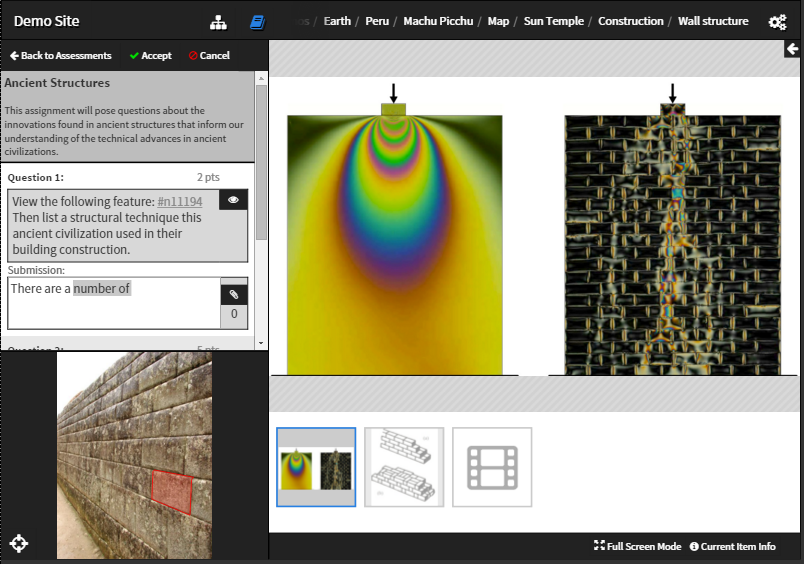
An instructor can create an interactive map site for students to analyze or assign students to create their own sites. Assessment functionality allows an instructor to assess student analysis of content within the site (faculty or student generated). Students can be graded on their work, work collaboratively in groups within the tool, and also view/compare what content their peers and other groups created.   

The application was originally developed for a general biology course to facilitate a collaborative digital field assignment for small teams of students in a large lecture class.  The interactive environment uses a map of the Homewood campus divided into approximately 60 mini-environments –called "biomes" – to which students are assigned for the academic year. Groups receive assignments biweekly. These assignments require them to conduct observations and collect data from their biome and then enter the data through the Interactive Map Application. Students then analyze their data in comparison to other student group biomes. Since the first implementation in biology, students  in other courses have used the application to map public murals by local artists around Baltimore City and to document the historical art of Florence Italy during the Renaissance.


Publications


Examples

Biomes of Homewood (Biology)
Cities Course (Multidisciplinary)
Florence Map (Humanities)


General Biology: Biomes of Homewood

Screen Shot: Biomes of Homewood The CER first developed the Interactive Map Tool for use in Hopkin’s General Biology course to facilitate collaborative, problem-based learning outside of class in which student teams (5-6 individuals) are assigned to specific areas on campus for an academic year. Using this tool, faculty write and distribute assignments to the 300+ students. The students are assigned to specific areas called “biomes." Teams use cell phones, digital audio recorders, and cameras to collect data and upload it to their biome on the map tool. Faculty and upperclassman assigned as mentors review, provide comments, and grade the assignments through the application.

Students can view data submitted by all teams enabling faculty to devise assignments in which student teams examine and compare data from one area to another, thereby promoting interaction among the student groups. In addition, data are retained from year to year so students can conduct longitudinal comparisons and make hypotheses about why the data vary in the biomes over time.

The map has permitted all students to experience virtual laboratory assignments and has helped to turn their large lecture introductory course into an active, team-based learning environment.


Cities Course

Screen Shot: Cities CourseThe interactive map was used to support digital field assignments in the course, The City: A Multidisciplinary Perspective. This seminar course offers an interdisciplinary approach to the study of urban issues. The primary instructional goal is for students to describe and analyze how a common topic − the city − can be examined through the lens of a variety of disciplines and appreciate each discipline’s contribution to the analysis. The secondary goal is for students to describe and analyze the character of urban living. Each week students attend a lecture led by a faculty member from a different discipline or an individual who works on urban issues. The two primary faculty sponsors of the course then lead a discussion to connect key ideas and themes between lectures.

For the final project, student teams investigated urban issues in broad categories such as public health, public art, or public safety by collecting data in situ. Each student on a team assumed the role of a different type of researcher (e.g., economist, criminologist, art historian). In these roles, students conducted interviews with public health experts, teachers, and others using portable audio recorders or iPods equipped with microphones. They recorded video of needle exchange truck workers on the job. They photographed life on the streets of Baltimore and public murals around the city. Each team assembled its digital images, sound, and video into an interactive, multimedia map using CER’s interactive map tool. The tool enabled students to analyze their data spatially and to also present multi-faceted reports to the class.


Florence Map

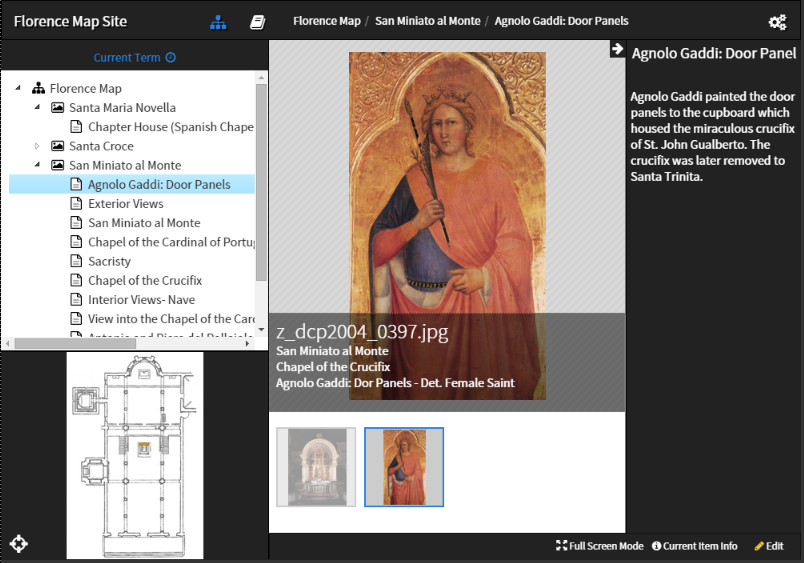
Screen Shot: Florence Map The Florence Map is an interactive teaching resource for the course, Renaissance Florence. The course examined the visual and material culture of the city of Florence from 1280 to 1500, chiefly architecture, painting, sculpture, and the arts of the book, with particular attention to the context of urban life.
The problem teaching this course is to convey a sense of this multilayered contextual meaning and of the original spatial and physical context of an object. Works of art influence and are influenced by the experience of urban life in a number of crucial ways: they are encountered as part of the urban space, they function within specific environments that charge the object with meaning; they provide a focus for memory, social identity and devotional attention for individuals and groups. Teaching with slides in a classroom can only do this to a limited extent. What is needed is a teaching resource which offers a sense of the spatial milieu in which objects were experienced, which can convey how the object operates as part of the urban topography of the late medieval/early modern city. The intention is, therefore, to produce an interactive web-based map of the city of Florence, to be used by an instructor within the classroom, and to be used by students for personal study.

The interactive map of Florence communicates the layout of the town and key architectural monuments. Clicking on a building reveals its original floor plan and the location of major works of art originally housed in the structures. Users can ‘tour’ the buildings, viewing art such as paintings, sculptures, and frescoes. A narrative accompanies each work to supplement the visual cues of the map.
As the site is interactive and allows the student to explore the various threads that make up the complex fabric of the city of Florence at this time period, it is possible for the student to pose and answer questions about the relationships among the people, places and objects under examination. The students are able to explore and analyze information about the urban environment of the era and draw conclusions about the meaning and relevance of the architecture and objects to the individuals and groups who experienced them. For instance, a series of paintings in the same church might cumulatively reinforce the religious experience of one kind of viewer, or, given the fact that such paintings are often marked with the identities of the family or group interests for whom they were produced, they might reinforce a sense of competition for another kind of beholder. Students perceive the relationship between site location and the relative political and social importance of objects created for the same structure.